
Every layer belongs
to somebody else
Overview
What the chain is made of, and why dependency becomes leverage.
Read more 
Layers
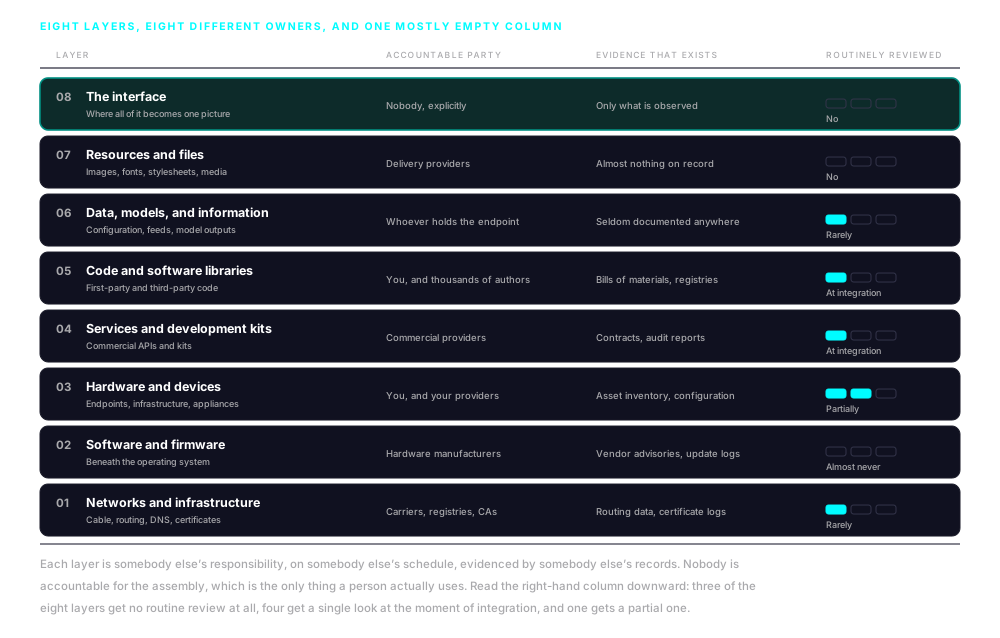
Eight layers, eight owners, and one mostly empty column.
Control
Ownership changes without changing a line of code.
Read more
Boundary
Nine tools already in use, and where each one stops.
Read more
Mapping
Capture, resolution, attribution, and reconciliation.
Read more
The digital supply chain is not a single chain. It is a set of overlapping, interdependent chains running at once through every technology stack in the world. The layers are distinct in technical character and tightly coupled in their dependencies, and a change at any one of them travels forward through everything built on top of it.
Which layer a finding sits in determines what can be done about it. How the layers interact is what produced the finding in the first place.


The Stack

Who owns each layer

Structure
Eight layers sit between a request and what a person sees
From the cable in the ground to the picture on the screen. Each layer depends on the ones beneath it, and each one is the responsibility of a different set of parties, reviewed on a different schedule, by people who rarely speak to each other.
01
Networks and infrastructure
Cable, fiber, spectrum, satellite, routing equipment, and the data centers that hold everything else. Above the physical sits the logical: the name system that turns an address into a destination, the routing protocol that decides the path, and the certificate authorities on which every secure connection rests. A hijacked route or a fraudulently issued certificate places a party in the path that the application above has no way to detect. The padlock still appears.
02
Software and firmware
The embedded software that controls how hardware behaves, sitting beneath the operating system in network equipment, servers, end-user machines, and industrial hardware. It is written by manufacturers, seldom subjected to the review applied to application code, and updated through channels most organizations do not watch. It also survives almost everything done to the layers above it.
03
Hardware and devices
The machine a person is actually looking at, the servers behind every provider in the chain, the appliances in between, and the expanding set of industrial, building, medical, and utility systems that now present browser-based operator interfaces. Those interfaces are assembled from the same supply chain as any other web application, and the decisions taken from what they display have physical consequences.
04
Services and development kits
The commercial APIs and development kits organizations integrate rather than build. An SDK is not a passive data connection; it is executable code running with the permissions of the application hosting it. The organization reviewed version one at integration. The provider is shipping version fourteen, with materially broader capabilities, to everyone who ever integrated any version.
05
Code and software libraries
First-party code, and the substantially larger body of third-party code brought in from outside. Some of it is compiled into the application and fixed at the version chosen. Much of it is not: it is held by other parties and loaded from their systems when the application runs, which is why a bill of materials, being a record of what was assembled, does not describe it.
06
Data, models, and information
Applications do not only load code. They load configuration, feature flags, content feeds, localization strings, API responses, and increasingly the outputs of models hosted by third parties. Each is a supply chain input the application processes and, in most cases, puts on screen. It is also the least documented layer in the stack: there is rarely any record of which endpoints an application consults, still less of who holds them, and model providers have arrived as a class of sub-processor faster than disclosure practice has adjusted to them.
07
Resources and files
Images, fonts, stylesheets, video, audio, and documents. Not executable, and not passive either: a stylesheet decides what is visible and what is obscured, a font decides which characters are drawn, an image carries information straight into a person's judgment, and a document served through an application is read as the original because nothing on the page suggests otherwise.
08
The interface
Every layer below converges here, into the single picture a person reads and acts on. It is the only place the assembled chain is visible as a whole, and it is the place no framework in common use looks at. Each was built to confirm that individual components function as specified, and an assembly is not a component.
As a System
Exposure comes from the interaction between layers
Code depends on data. Data travels over networks. Networks route through hardware. Hardware runs firmware. Services consume and produce the data that code acts on. Resources are delivered by providers who are themselves networks of hardware running firmware. A change at any layer propagates through every layer above it that depends on it.
So the attack surface is not the sum of the weaknesses in each layer taken separately. It is the set of pathways by which a change at one layer reaches the interface through several others. That is precisely what component-level tooling is built to miss: the change is distributed, the evidence is fragmented across layers owned by different parties, and the assembled result is visible only where they converge.
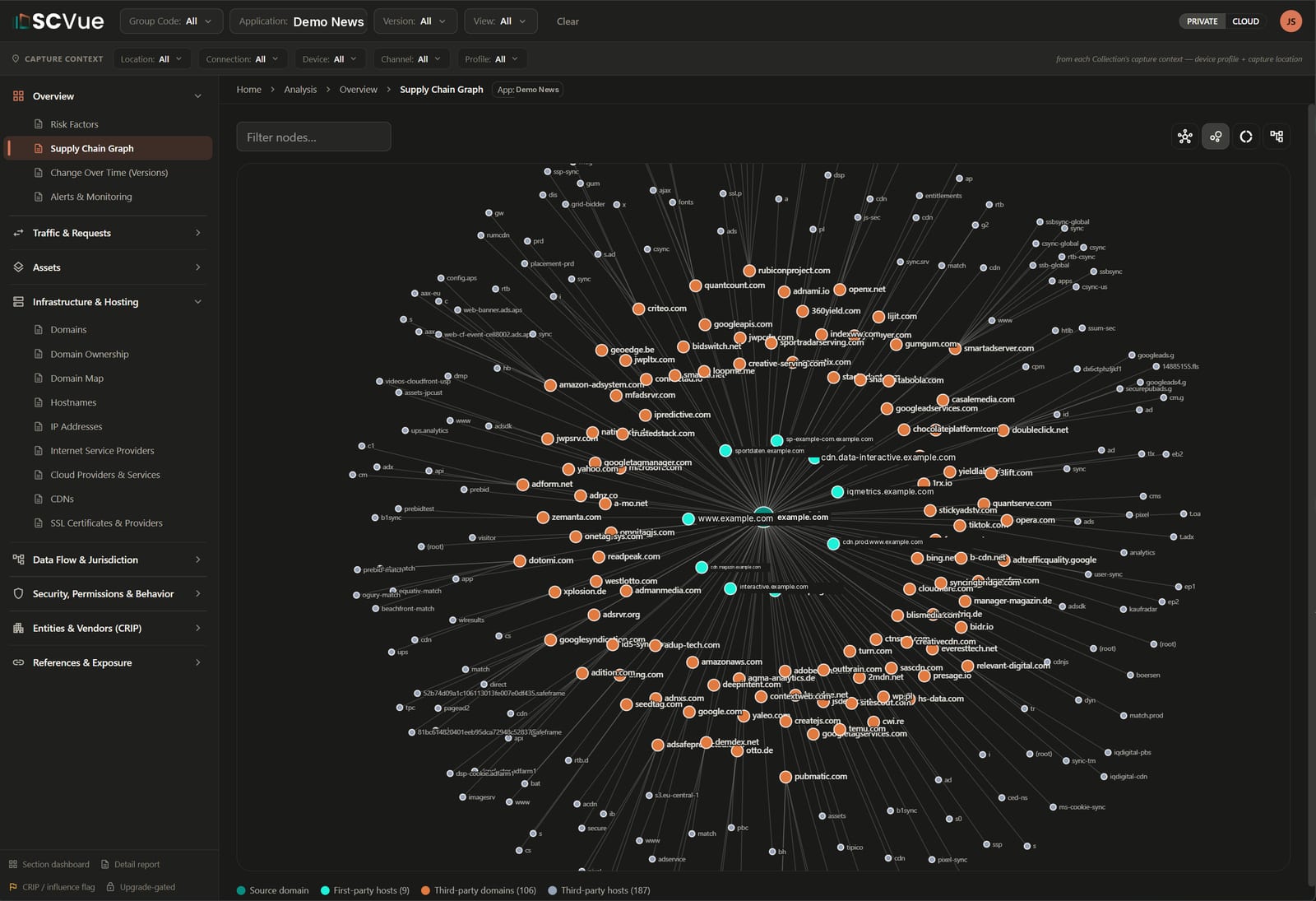
The layers as they appear in one observed session, rather than as an architecture diagram. Read the mapping method.

Evidence
Some layers leave a record. Several leave almost none.
No single source covers the stack. Four bodies of evidence between them come close, and each was assembled by different people for different reasons. Most of the value sits in the places where they contradict each other.
Observed behavior
What the application actually did: the requests it made, the code it executed, the payloads it sent, the storage it wrote. Primary evidence for the code, data, resource, and service layers, and the only source that reflects the assembly rather than its parts.
Technical registries
Domain registration, address allocation, routing announcements, certificate transparency, and hosting records. These turn an observed host into a named operator, and they are how the network layer becomes something a person can reason about.
Declarations and contracts
Sub-processor lists, data-processing agreements, audit reports, bills of materials, and procurement records. Not the ground truth, but the claim under test. Where disclosure is mandated, an omission is itself reportable.
Corporate records
Registries, filings, funding records, sanctions and enforcement data. These carry an operator through to a company, its owners, and the jurisdiction whose law governs what it does with your data. Equity Chain Mapping takes it from there.
One session crosses all eight layers at once
No organization can audit eight layers belonging to hundreds of parties, and none needs to. A single captured session records every party the assembled application actually contacted, across all eight layers at the same time, without asking any of them for a list. Resolving those parties to the companies behind them, and setting the result against what was declared, is the method.

Request a
Briefing
We walk through real-world use cases drawn from active engagements that demonstrate why supply chain integrity now requires senior-level attention and coordinated action.

Subscribe to stay informed on global supply chain integrity developments and nDiligence updates.
Copyright © 2026 nDiligence, Inc. All Rights Reserved.